13916964679

Note: Application as IHC, only suitable for histochemical staining or fluorescence staining of paraffin-embedded sections. Application as ICC/IF, suitable for histochemical or fluorescent staining of frozen sections, as well as chemical and fluorescent staining at the cellular level.
注意:抗体应用为IHC的,抗体只适合于石蜡切片的组化染色或者荧光染色。
抗体应用为IF/ICC的,抗体适合于冰冻切片的组化染色或者荧光染色,以及细胞水平的化学染色和荧光染色。
ABMART实验方案下载
Transmembrane receptor that functions as a pattern recognition receptor recognizing pathogen- and damage-associated molecular patterns (PAMPs and DAMPs) to induce innate immune responses via downstream signaling pathways . At the plasma membrane, cooperates with LY96 to mediate the innate immune response to bacterial lipopolysaccharide (LPS) . Also involved in LPS-independent inflammatory responses triggered by free fatty acids, such as palmitate, and Ni(2+) . Mechanistically, acts via MYD88, TIRAP and TRAF6, leading to NF-kappa-B activation, cytokine secretion and the inflammatory response . Alternatively, CD14-mediated TLR4 internalization via endocytosis is associated with the initiation of a MYD88-independent signaling via the TICAM1-TBK1-IRF3 axis leading to type I interferon production . In addition to the secretion of proinflammatory cytokines, initiates the activation of NLRP3 inflammasome and formation of a positive feedback loop between autophagy and NF-kappa-B signaling cascade . In complex with TLR6, promotes inflammation in monocytes/macrophages by associating with TLR6 and the receptor CD86 . Upon ligand binding, such as oxLDL or amyloid-beta 42, the TLR4:TLR6 complex is internalized and triggers inflammatory response, leading to NF-kappa-B-dependent production of CXCL1, CXCL2 and CCL9 cytokines, via MYD88 signaling pathway, and CCL5 cytokine, via TICAM1 signaling pathway . In myeloid dendritic cells, vesicular stomatitis virus glycoprotein G but not LPS promotes the activation of IRF7, leading to type I IFN production in a CD14-dependent manner . Required for the migration-promoting effects of ZG16B/PAUF on pancreatic cancer cells. .
Toll-like receptor 4 (hToll) (CD antigen CD284) TLR4
Human,Rat,Mouse
WB,IHC,IF,ICC
WB 1:1000-1:2000IHC 1:50-1:200IF 1:100-1:400ICC 1:100-1:400
96kD
TLR4
Q9QUK6,Q9QX05,O00206
Rabbit
Polyclonal
Rabbit IgG
defense response to bacterium
Product Information
Description | TLR4 rabbit polyclonal |
Protein full name | Toll-like receptor 4 |
Synonyms | TLR4, ARMD10, CD284, TLR-4, TOLL, toll like receptor 4 |
Immunogen | KLH conjugated Synthetic peptide corresponding to Mouse TLR4. |
Isotype | IgG |
Purity | Affinity purification |
Predicted MW. | 95 KDa |
Observed MW. | 95 KDa |
Subcellular location | Membrane |
Uniprot ID |
Applications
applications | species | dilution | Positive tissue |
WB | Human, Mouse, Rat | 1: 1000 | spleen, lung, thymus |
IHC | Mouse, Rat | 1: 1000-1: 2000 | spleen, lymph |
IF | Mouse, Rat | 1: 1000-1: 2000 | spleen, lymph |
Background
A member of the toll-like receptor (TLR) family, which plays a fundamental
role in pathogen recognition and activation of innate immunity. It
cooperates with LY96 (also referred as MD-2) and CD14 to mediate
in signal transduction events induced by lipopolysaccharide (LPS) found
in most gram-negative bacteria. Mutations in this gene have been
associated with differences in LPS responsiveness. TLR4 signaling
responds to signals by forming a complex using an extracellular
leucine-rich repeat domain (LRR) and an intracellular toll/interleukin-1
receptor (TIR) domain.
Images
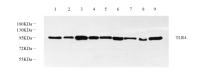 | Western blot analysis of TLR4 (T61519M) at dilution of 1:1000. Lane 1: Jurkat cell lysate Lane 2: Raw264.7 cell lysate Lane 3: A20 cell lysate Lane 4: Mouse spleen tissue lysate Lane 5: Mouse lung tissue lysate Lane 6: Mouse thymus tissue lysate Lane 7: Rat spleen tissue lysate Lane 8: Rat lung tissue lysate Lane 9: Rat thymus tissue lysate |
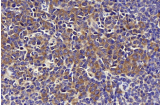 | Immunohistochemistry analysis of paraffin-embedded mouse spleen using TLR4 (T61519M) at dilution of 1:2000 |
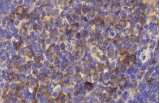 | Immunohistochemistry analysis of paraffin-embedded rat spleen using TLR4 (T61519M) at dilution of 1:2000 |
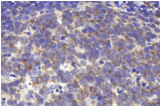 | Immunohistochemistry analysis of paraffin-embedded rat lymph using TLR4 (T61519M) at dilution of 1:2000 |
Storage
| Storage | Store at -20 ℃ for one year. Avoid repeated freeze/ thaw cycles. |
| Storage Buffer | PBS with 0.02% sodium azide, 100 mu;g/ml BSA and 50% glycerol. |
NOTE: This product is intended for research only.
Store at +4℃ after thawing. For long-term storage, please store it at -20℃. Avoid repeated freeze / thaw cycles.
AB_3712450




艾比玛特医药科技(上海)有限公司
上海市徐汇区桂平路333号聚科生物园区1号楼1-3层
邮箱:market@ab-mart.com
应聘职位:hr@ab-mart.com
订购专线:4006-123-828
销售电话:13916964679(微信同号)
技术支持:15618194176(微信同号)
华南经销商负责(广东,广西,福建,海南):
程经理:手机18616261485(微信同号)
华北经销商负责(北京,天津,河北):
徐经理:手机15618191473(微信同号)
南方经销商负责:
陆经理:手机13122837132(微信同号)
北方及西南经销商负责:
张经理:手机13122150513(微信同号)

微信客服
邮箱:market@ab-mart.com
应聘职位:hr@ab-mart.com
订购专线:4006-123-828
销售电话:13916964679(微信同号)
技术支持:15618194176(微信同号)
华南经销商负责(广东,广西,福建,海南):
程经理:手机18616261485(微信同号)
华北经销商负责(北京,天津,河北):
徐经理:手机15618191473(微信同号)
南方经销商负责:
陆经理:手机13122837132(微信同号)
北方及西南经销商负责:
张经理:手机13122150513(微信同号)
微信客服
沪ICP备17056956号-2 艾比玛特医药科技(上海)有限公司