13916964679

Note: Application as IHC, only suitable for histochemical staining or fluorescence staining of paraffin-embedded sections. Application as ICC/IF, suitable for histochemical or fluorescent staining of frozen sections, as well as chemical and fluorescent staining at the cellular level.
注意:抗体应用为IHC的,抗体只适合于石蜡切片的组化染色或者荧光染色。
抗体应用为IF/ICC的,抗体适合于冰冻切片的组化染色或者荧光染色,以及细胞水平的化学染色和荧光染色。
ABMART实验方案下载
[Gag-Pol polyprotein]: Plays a role in budding and is processed by the viral protease during virion maturation outside the cell. During budding, it recruits, in a PPXY-dependent or independent manner, Nedd4-like ubiquitin ligases that conjugate ubiquitin molecules to Gag-Pol, or to Gag-Pol binding host factors. Interaction with HECT ubiquitin ligases probably links the viral protein to the host ESCRT pathway and facilitates release. .; [Matrix protein p15]: Targets Gag and gag-pol polyproteins to the plasma membrane via a multipartite membrane binding signal, that includes its myristoylated N-terminus. Also mediates nuclear localization of the pre-integration complex. .; [RNA-binding phosphoprotein p12]: Constituent of the pre-integration complex (PIC) which tethers the latter to mitotic chromosomes. This allows the integration of the viral genome into the host DNA. .; [Capsid protein p30]: Forms the spherical core of the virion that encapsulates the genomic RNA-nucleocapsid complex. .; [Nucleocapsid protein p10-Pol]: Involved in the packaging and encapsidation of two copies of the genome (By similarity). Binds with high affinity to conserved UCUG elements within the packaging signal, located near the 5'-end of the genome (By similarity). This binding is dependent on genome dimerization (By similarity). Acts as a nucleic acid chaperone which is involved in rearrangement of nucleic acid secondary structures during gRNA retrotranscription . .; [Protease]: The aspartyl protease mediates proteolytic cleavages of Gag and Gag-Pol polyproteins during or shortly after the release of the virion from the plasma membrane. Cleavages take place as an ordered, step-wise cascade to yield mature proteins. This process is called maturation. Displays maximal activity during the budding process just prior to particle release from the cell (Potential). Cleaves the translation initiation factor eIF4G leading to the inhibition of host cap-dependent translation . .; [Reverse transcriptase/ribonuclease H]: RT is a multifunctional enzyme that converts the viral dimeric RNA genome into dsDNA in the cytoplasm, shortly after virus entry into the cell. This enzyme displays a DNA polymerase activity that can copy either DNA or RNA templates, and a ribonuclease H (RNase H) activity that cleaves the RNA strand of RNA-DNA heteroduplexes in a partially processive 3' to 5' endonucleasic mode. Conversion of viral genomic RNA into dsDNA requires many steps. A tRNA binds to the primer-binding site (PBS) situated at the 5' end of the viral RNA. RT uses the 3' end of the tRNA primer to perform a short round of RNA-dependent minus-strand DNA synthesis. The reading proceeds through the U5 region and ends after the repeated (R) region which is present at both ends of viral RNA. The portion of the RNA-DNA heteroduplex is digested by the RNase H, resulting in a ssDNA product attached to the tRNA primer. This ssDNA/tRNA hybridizes with the identical R region situated at the 3' end of viral RNA. This template exchange, known as minus-strand DNA strong stop transfer, can be either intra- or intermolecular. RT uses the 3' end of this newly synthesized short ssDNA to perform the RNA-dependent minus-strand DNA synthesis of the whole template. RNase H digests the RNA template except for a polypurine tract (PPT) situated at the 5' end of the genome. It is not clear if both polymerase and RNase H activities are simultaneous. RNase H probably can proceed both in a polymerase-dependent (RNA cut into small fragments by the same RT performing DNA synthesis) and a polymerase-independent mode (cleavage of remaining RNA fragments by free RTs). Secondly, RT performs DNA-directed plus-strand DNA synthesis using the PPT that has not been removed by RNase H as primers. PPT and tRNA primers are then removed by RNase H. The 3' and 5' ssDNA PBS regions hybridize to form a circular dsDNA intermediate. Strand displacement synthesis by RT to the PBS and PPT ends produces a blunt ended, linear dsDNA copy of the viral genome that includes long terminal repeats (LTRs) at both ends. .; [Integrase]: Catalyzes viral DNA integration into the host chromosome, by performing a series of DNA cutting and joining reactions. This enzyme activity takes place after virion entry into a cell and reverse transcription of the RNA genome in dsDNA. The first step in the integration process is 3' processing. This step requires a complex comprising the viral genome, matrix protein and integrase. This complex is called the pre-integration complex (PIC). The integrase protein removes 2 nucleotides from each 3' end of the viral DNA, leaving recessed CA OH's at the 3' ends. In the second step that requires cell division, the PIC enters cell nucleus. In the third step, termed strand transfer, the integrase protein joins the previously processed 3' ends to the 5' ends of strands of target cellular DNA at the site of integration. The last step is viral DNA integration into host chromosome. .
Gag-Pol polyprotein (Pr180gag-pol) [Cleaved into: Matrix protein p15 (MA); RNA-binding phosphoprotein p12 (pp12); Capsid protein p30 (CA); Nucleocapsid protein p10-Pol (NC-pol); Protease (PR) (EC 3.4.23.-) (p14); Reverse transcriptase/ribonuclease H (RT) (EC 2.7.7.49) (EC 2.7.7.7) (EC 3.1.26.4) (p80); Integrase (IN) (EC 2.7.7.-) (EC 3.1.-.-) (p46)] gag-pol
Moloney murine leukemia virus (isolate Shinnick) (MoMLV)
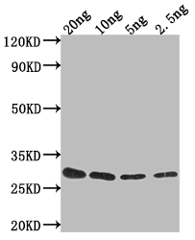
WB,ELISA
WB 1:1000-1:2000ELISA 1:5000-1:20000
195kD
gag-pol
p03355
Recombinant Moloney murine leukemia virus (isolate Shinnick) (MoMLV) POL protein (1444-1738aa)
Rabbit
Polyclonal
IgG
DNA recombination #Host gene expression shutoff by virus #Virus entry into host cell #Viral genome integration #DNA recombination #proteolysis,
Protein G
Liquid
1mg/ml
Preservative: 0.03% Proclin 300
Constituents: 50% Glycerol, 0.01M PBS, pH 7.4
Store at +4℃ after thawing. For long-term storage, please store it at -20℃. Avoid repeated freeze / thaw cycles.




艾比玛特医药科技(上海)有限公司
上海市徐汇区桂平路333号聚科生物园区1号楼1-3层
邮箱:market@ab-mart.com
应聘职位:hr@ab-mart.com
订购专线:4006-123-828
销售电话:13916964679(微信同号)
技术支持:15618194176(微信同号)
华南经销商负责(广东,广西,福建,海南):
程经理:手机18616261485(微信同号)
华北经销商负责(北京,天津,河北):
徐经理:手机15618191473(微信同号)
南方经销商负责:
陆经理:手机13122837132(微信同号)
北方及西南经销商负责:
张经理:手机13122150513(微信同号)

微信客服
邮箱:market@ab-mart.com
应聘职位:hr@ab-mart.com
订购专线:4006-123-828
销售电话:13916964679(微信同号)
技术支持:15618194176(微信同号)
华南经销商负责(广东,广西,福建,海南):
程经理:手机18616261485(微信同号)
华北经销商负责(北京,天津,河北):
徐经理:手机15618191473(微信同号)
南方经销商负责:
陆经理:手机13122837132(微信同号)
北方及西南经销商负责:
张经理:手机13122150513(微信同号)
微信客服
沪ICP备17056956号-2 艾比玛特医药科技(上海)有限公司