13916964679

Note: Application as IHC, only suitable for histochemical staining or fluorescence staining of paraffin-embedded sections. Application as ICC/IF, suitable for histochemical or fluorescent staining of frozen sections, as well as chemical and fluorescent staining at the cellular level.
注意:抗体应用为IHC的,抗体只适合于石蜡切片的组化染色或者荧光染色。
抗体应用为IF/ICC的,抗体适合于冰冻切片的组化染色或者荧光染色,以及细胞水平的化学染色和荧光染色。
ABMART实验方案下载
VEGF Receptor 1 (also known as FLT) belongs to the src gene family and shows tyrosine protein kinase activity that is important for the control of cell proliferation and differentiation. The protein acts as a receptor for VEGF, VEGFB and PGF. An alternatively spliced form of the gene produces a soluble protein (sFlt1) which binds vascular endothelial growth factor (VEGF) with high affinity. sFlt1 has a higher affinity for VEGF indicating that it may function as an inhibitor in the VEGF response. VEGF Receptor 1 is specifically expressed in most vascular endothelial cells and peripheral blood monocytes.
EC 2.7.10; EC 2.7.10.1; Vascular endothelial growth factor receptor 1; VEGF-R1; VEGFR-1; VEGF Receptor 1; FLT-1; vascular permeability factor receptor; vascular endothelial growth factor receptor; vascular endothelial growth factor receptor-1; fms-related tyrosine kinase 1; vascular endothelial growth factor/vascular permeability factor receptor; AI323757; F< FLT1; sFlt1; VGFR1_HUMAN; Recombinant human VEGFR1 protein, C-His-Avi (HEK293)
Lyophilized
AC
85
>0.5 mg/ml
Lyophilized from 0.22um filtered solution in PBS (pH7.4) with 5mM DTT. Normally 5% trehalose is added as protectant before Lyophilization.
Cancer > Cancer Metabolism > Response to hypoxia
Cancer > Growth factors > VEGF
Cancer > Invasion/microenvironment > Angiogenesis > Angiogenic growth factors
Cancer > Oncoproteins/suppressors > Oncoproteins > Growth factors
Cardiovascular > Angiogenesis > Endothelial Cell Markers
Cardiovascular > Angiogenesis > Growth Factors > VEGF > VEGF Receptors
Cardiovascular > Vasculature > Endothelium
Metabolism > Pathways and Processes > Metabolism processes > Hypoxia
Metabolism > Types of disease > Cancer
Signal Transduction > Growth Factors/Hormones > VEGF
Signal Transduction > Protein Phosphorylation > Tyrosine Kinases
Tyrosine-protein kinase that acts as a cell-surface receptor for VEGFA, VEGFB and PGF, and plays an essential role in the development of embryonic vasculature, the regulation of angiogenesis, cell survival, cell migration, macrophage function, chemotaxis, and cancer cell invasion. May play an essential role as a negative regulator of embryonic angiogenesis by inhibiting excessive proliferation of endothelial cells. Can promote endothelial cell proliferation, survival and angiogenesis in adulthood. Its function in promoting cell proliferation seems to be cell-type specific. Promotes PGF-mediated proliferation of endothelial cells, and proliferation of some types of cancer cells, but does not promote proliferation of normal fibroblasts. Has very high affinity for VEGFA and relatively low protein kinase activity; may function as a negative regulator of VEGFA signaling by limiting the amount of free VEGFA and preventing its binding to KDR. Modulates KDR signaling by forming heterodimers with KDR. Ligand binding leads to the activation of several signaling cascades. Activation of PLCG1 leads to the production of the cellular signaling molecules diacylglycerol and inositol 1,4,5-trisphosphate and the activation of protein kinase C. Mediates phosphorylation of PIK3R1, the regulatory subunit of phosphatidylinositol 3-kinase, leading to the activation of phosphatidylinositol kinase and the downstream signaling pathway. Mediates activation of MAPK1/ERK2, Interacts with VEGFA, VEGFB and PGF. Monomer in the absence of bound VEGFA, VEGFB or PGF. Homodimer in the presence of bound VEGFA, VEGFB and PGF. Can also form a heterodimer with KDR.Interacts (when tyrosine phosphorylated) with CBL, CRK, GRB2, NCK1,PIK3R1, PLCG1 and PTPN11. Interacts with GNB2L1/RACK1. Identified in a complex with CBL and CD2AP.
Isoform 1: Cell membrane; Single-pass type I membrane protein. Endosome. Note=Autophosphorylation promotes ubiquitination and endocytosis;Isoform 2: Secreted;Isoform 3: Secreted;Isoform 4: Secreted;Isoform 5: Cytoplasm (Potential);Isoform 6: Cytoplasm (Potential);Isoform 7: Cytoplasm (Potential).
Detected in normal lung, but also in placenta,liver, kidney, heart and brain tissues. Specifically expressed in most of the vascular endothelial cells, and also expressed in peripheral blood monocytes. Isoform 2 is strongly expressed in placenta. Isoform 3 is expressed in corneal epithelial cells (at protein level). Isoform 3 is expressed in vascular smooth muscle cells (VSMC).
N-glycosylated.
Ubiquitinated after VEGFA-mediated autophosphorylation, leading to proteolytic degradation.
Autophosphorylated on tyrosine residues upon ligand binding. Autophosphorylation occurs in trans, i.e. one subunit of the dimeric receptor phosphorylates tyrosine residues on the other subunit. Phosphorylation at Tyr-1169 is important for interaction with PLCG1. Phosphorylation at Tyr-1213 is important for interaction with PIK3R1, PTPN11, GRB2, and PLCG1. Phosphorylation at Tyr-1331 is important for endocytosis and for interaction with CBL, NCK1 and CRK.
Belongs to the protein kinase superfamily. Tyr protein kinase family. CSF-1/PDGF receptor subfamily.Contains 7 Ig-like C2-type (immunoglobulin-like)domains.Contains 1 protein kinase domain.
Not tested
27-756/1338
C-His-Avi
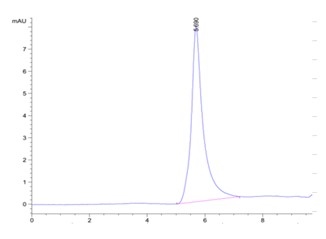
>95% as determined by Tris-Bis PAGE; >95% as determined by SEC-HPLC
<1.0 EU/μg as determined by LAL
HEK293 cell
Centrifuge tubes before opening. Reconstituting to a concentration more than 100 μg/ml is recommended. Dissolve the lyophilized protein in distilled water.
Following activation by double-stranded RNA in the presence of ATP, the kinase becomes autophosphorylated and can catalyze the phosphorylation of the translation initiation factor EIF2S1, which leads to an inhibition of the initiation of protein synthesis. Doub
Stored at -70℃ or -20℃. Avoid repeated freeze/thaw cycles.
This product as supplied is intended for research use only, not for use in human, therapeutic or diagnostic applications.




艾比玛特医药科技(上海)有限公司
上海市徐汇区桂平路333号聚科生物园区1号楼1-3层
邮箱:market@ab-mart.com
应聘职位:hr@ab-mart.com
订购专线:4006-123-828
销售电话:13916964679(微信同号)
技术支持:15618194176(微信同号)
华南经销商负责(广东,广西,福建,海南):
程经理:手机18616261485(微信同号)
华北经销商负责(北京,天津,河北):
徐经理:手机15618191473(微信同号)
南方经销商负责:
陆经理:手机13122837132(微信同号)
北方及西南经销商负责:
张经理:手机13122150513(微信同号)

微信客服
邮箱:market@ab-mart.com
应聘职位:hr@ab-mart.com
订购专线:4006-123-828
销售电话:13916964679(微信同号)
技术支持:15618194176(微信同号)
华南经销商负责(广东,广西,福建,海南):
程经理:手机18616261485(微信同号)
华北经销商负责(北京,天津,河北):
徐经理:手机15618191473(微信同号)
南方经销商负责:
陆经理:手机13122837132(微信同号)
北方及西南经销商负责:
张经理:手机13122150513(微信同号)
微信客服
沪ICP备17056956号-2 艾比玛特医药科技(上海)有限公司



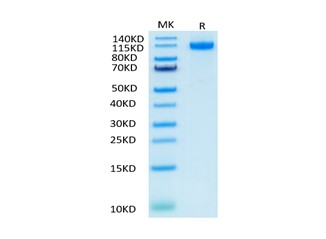 Recombinant VEGFR1 Protein on Tris-Bis PAGE under reduced conditions. The purity is greater than 95%.