13916964679

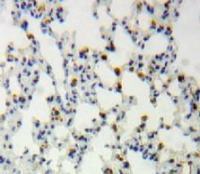
Note: Application as IHC, only suitable for histochemical staining or fluorescence staining of paraffin-embedded sections. Application as ICC/IF, suitable for histochemical or fluorescent staining of frozen sections, as well as chemical and fluorescent staining at the cellular level.
注意:抗体应用为IHC的,抗体只适合于石蜡切片的组化染色或者荧光染色。
抗体应用为IF/ICC的,抗体适合于冰冻切片的组化染色或者荧光染色,以及细胞水平的化学染色和荧光染色。
ABMART实验方案下载
NAD-dependent protein deacetylase that links transcriptional regulation directly to intracellular energetics and participates in the coordination of several separated cellular functions such as cell cycle, response to DNA damage, metabolism, apoptosis and autophagy . Can modulate chromatin function through deacetylation of histones and can promote alterations in the methylation of histones and DNA, leading to transcriptional repression (By similarity). Deacetylates a broad range of transcription factors and coregulators, thereby regulating target gene expression positively and negatively (By similarity). Serves as a sensor of the cytosolic ratio of NAD(+)/NADH which is altered by glucose deprivation and metabolic changes associated with caloric restriction (By similarity). Is essential in skeletal muscle cell differentiation and in response to low nutrients mediates the inhibitory effect on skeletal myoblast differentiation which also involves 5'-AMP-activated protein kinase (AMPK) and nicotinamide phosphoribosyltransferase (NAMPT) . Component of the eNoSC (energy-dependent nucleolar silencing) complex, a complex that mediates silencing of rDNA in response to intracellular energy status and acts by recruiting histone-modifying enzymes (By similarity). The eNoSC complex is able to sense the energy status of cell: upon glucose starvation, elevation of NAD(+)/NADP(+) ratio activates SIRT1, leading to histone H3 deacetylation followed by dimethylation of H3 at 'Lys-9' (H3K9me2) by SUV39H1 and the formation of silent chromatin in the rDNA locus . Deacetylates 'Lys-266' of SUV39H1, leading to its activation (By similarity). Inhibits skeletal muscle differentiation by deacetylating PCAF and MYOD1 . Deacetylates H2A and 'Lys-26' of H1-4 (By similarity). Deacetylates 'Lys-16' of histone H4 (in vitro) (By similarity). Involved in NR0B2/SHP corepression function through chromatin remodeling: Recruited to LRH1 target gene promoters by NR0B2/SHP thereby stimulating histone H3 and H4 deacetylation leading to transcriptional repression (By similarity). Proposed to contribute to genomic integrity via positive regulation of telomere length; however, reports on localization to pericentromeric heterochromatin are conflicting . Proposed to play a role in constitutive heterochromatin (CH) formation and/or maintenance through regulation of the available pool of nuclear SUV39H1 (By similarity). Upon oxidative/metabolic stress decreases SUV39H1 degradation by inhibiting SUV39H1 polyubiquitination by MDM2 (By similarity). This increase in SUV39H1 levels enhances SUV39H1 turnover in CH, which in turn seems to accelerate renewal of the heterochromatin which correlates with greater genomic integrity during stress response (By similarity). Deacetylates 'Lys-382' of p53/TP53 and impairs its ability to induce transcription-dependent proapoptotic program and modulate cell senescence . Deacetylates TAF1B and thereby represses rDNA transcription by the RNA polymerase I . Deacetylates MYC, promotes the association of MYC with MAX and decreases MYC stability leading to compromised transformational capability (By similarity). Deacetylates FOXO3 in response to oxidative stress thereby increasing its ability to induce cell cycle arrest and resistance to oxidative stress but inhibiting FOXO3-mediated induction of apoptosis transcriptional activity; also leading to FOXO3 ubiquitination and protesomal degradation (By similarity). Appears to have a similar effect on MLLT7/FOXO4 in regulation of transcriptional activity and apoptosis (By similarity). Deacetylates DNMT1; thereby impairs DNMT1 methyltransferase-independent transcription repressor activity, modulates DNMT1 cell cycle regulatory function and DNMT1-mediated gene silencing (By similarity). Deacetylates RELA/NF-kappa-B p65 thereby inhibiting its transactivating potential and augments apoptosis in response to TNF-alpha (By similarity). Deacetylates HIF1A, KAT5/TIP60, RB1 and HIC1 . Deacetylates FOXO1, which increases its DNA binding ability and enhances its transcriptional activity leading to increased gluconeogenesis in liver . Inhibits E2F1 transcriptional activity and apoptotic function, possibly by deacetylation . Involved in HES1- and HEY2-mediated transcriptional repression (By similarity). In cooperation with MYCN seems to be involved in transcriptional repression of DUSP6/MAPK3 leading to MYCN stabilization by phosphorylation at 'Ser-62' (By similarity). Deacetylates MEF2D (By similarity). Required for antagonist-mediated transcription suppression of AR-dependent genes which may be linked to local deacetylation of histone H3 (By similarity). Represses HNF1A-mediated transcription . Required for the repression of ESRRG by CREBZF (By similarity). Deacetylates NR1H3 and NR1H2 and deacetylation of NR1H3 at 'Lys-434' positively regulates transcription of NR1H3:RXR target genes, promotes NR1H3 proteasomal degradation and results in cholesterol efflux; a promoter clearing mechanism after reach round of transcription is proposed . Involved in lipid metabolism: deacetylates LPIN1, thereby inhibiting diacylglycerol synthesis (By similarity). Implicated in regulation of adipogenesis and fat mobilization in white adipocytes by repression of PPARG which probably involves association with NCOR1 and SMRT/NCOR2 . Deacetylates p300/EP300 and PRMT1 . Deacetylates ACSS2 leading to its activation, and HMGCS1 deacetylation . Involved in liver and muscle metabolism (By similarity). Through deacetylation and activation of PPARGC1A is required to activate fatty acid oxidation in skeletal muscle under low-glucose conditions and is involved in glucose homeostasis . Involved in regulation of PPARA and fatty acid beta-oxidation in liver . Involved in positive regulation of insulin secretion in pancreatic beta cells in response to glucose; the function seems to imply transcriptional repression of UCP2 . Proposed to deacetylate IRS2 thereby facilitating its insulin-induced tyrosine phosphorylation . Deacetylates SREBF1 isoform SREBP-1C thereby decreasing its stability and transactivation in lipogenic gene expression (By similarity). Involved in DNA damage response by repressing genes which are involved in DNA repair, such as XPC and TP73, deacetylating XRCC6/Ku70, and facilitating recruitment of additional factors to sites of damaged DNA, such as SIRT1-deacetylated NBN can recruit ATM to initiate DNA repair and SIRT1-deacetylated XPA interacts with RPA2 (By similarity). Also involved in DNA repair of DNA double-strand breaks by homologous recombination and specifically single-strand annealing independently of XRCC6/Ku70 and NBN (By similarity). Promotes DNA double-strand breaks by mediating deacetylation of SIRT6 (By similarity). Transcriptional suppression of XPC probably involves an E2F4:RBL2 suppressor complex and protein kinase B (AKT) signaling (By similarity). Transcriptional suppression of TP73 probably involves E2F4 and PCAF (By similarity). Deacetylates WRN thereby regulating its helicase and exonuclease activities and regulates WRN nuclear translocation in response to DNA damage (By similarity). Deacetylates APEX1 at 'Lys-6' and 'Lys-7' and stimulates cellular AP endonuclease activity by promoting the association of APEX1 to XRCC1 (By similarity). Catalyzes deacetylation of ERCC4/XPF, thereby impairing interaction with ERCC1 and nucleotide excision repair (NER) (By similarity). Increases p53/TP53-mediated transcription-independent apoptosis by blocking nuclear translocation of cytoplasmic p53/TP53 and probably redirecting it to mitochondria (By similarity). Deacetylates XRCC6/Ku70 at 'Lys-537' and 'Lys-540' causing it to sequester BAX away from mitochondria thereby inhibiting stress-induced apoptosis (By similarity). Is involved in autophagy, presumably by deacetylating ATG5, ATG7 and MAP1LC3B/ATG8 . Deacetylates AKT1 which leads to enhanced binding of AKT1 and PDK1 to PIP3 and promotes their activation (By similarity). Proposed to play role in regulation of STK11/LBK1-dependent AMPK signaling pathways implicated in cellular senescence which seems to involve the regulation of the acetylation status of STK11/LBK1 . Can deacetylate STK11/LBK1 and thereby increase its activity, cytoplasmic localization and association with STRAD; however, the relevance of such activity in normal cells is unclear (By similarity). In endothelial cells is shown to inhibit STK11/LBK1 activity and to promote its degradation (By similarity). Deacetylates SMAD7 at 'Lys-64' and 'Lys-70' thereby promoting its degradation . Deacetylates CIITA and augments its MHC class II transactivation and contributes to its stability (By similarity). Deacetylates MECOM/EVI1 (By similarity). Deacetylates PML at 'Lys-487' and this deacetylation promotes PML control of PER2 nuclear localization (By similarity). During the neurogenic transition, represses selective NOTCH1-target genes through histone deacetylation in a BCL6-dependent manner and leading to neuronal differentiation (By similarity). Regulates the circadian expression of several core clock genes, including BMAL1, RORC, PER2 and CRY1 and plays a critical role in maintaining a controlled rhythmicity in histone acetylation, thereby contributing to circadian chromatin remodeling . Deacetylates BMAL1 and histones at the circadian gene promoters in order to facilitate repression by inhibitory components of the circadian oscillator . Deacetylates PER2, facilitating its ubiquitination and degradation by the proteasome . Protects cardiomyocytes against palmitate-induced apoptosis . Deacetylates XBP1 isoform 2; deacetylation decreases protein stability of XBP1 isoform 2 and inhibits its transcriptional activity (By similarity). Deacetylates PCK1 and directs its activity toward phosphoenolpyruvate production promoting gluconeogenesis . Involved in the CCAR2-mediated regulation of PCK1 and NR1D1 (By similarity). Deacetylates CTNB1 at 'Lys-49' (By similarity). In POMC (pro-opiomelanocortin) neurons, required for leptin-induced activation of PI3K signaling . In addition to protein deacetylase activity, also acts as a protein-lysine deacylase by mediating protein depropionylation and decrotonylation . Mediates depropionylation of Osterix (SP7) . Catalyzes decrotonylation of histones; it however does not represent a major histone decrotonylase (By similarity). Deacetylates SOX9; promoting SOX9 nuclear localization and transactivation activity . Involved in the regulation of centrosome duplication. Deacetylates CENATAC in G1 phase, allowing for SASS6 accumulation on the centrosome and subsequent procentriole assembly (By similarity). Deacetylates NDC80/HEC1 (By similarity). .; [Isoform 2]: Deacetylates 'Lys-382' of p53/TP53, however with lower activity than isoform 1. In combination, the two isoforms exert an additive effect. Isoform 2 regulates p53/TP53 expression and cellular stress response and is in turn repressed by p53/TP53 presenting a SIRT1 isoform-dependent auto-regulatory loop. .; [SirtT1 75 kDa fragment]: Catalytically inactive 75SirT1 may be involved in regulation of apoptosis. May be involved in protecting chondrocytes from apoptotic death by associating with cytochrome C and interfering with apoptosome assembly. .
NAD-dependent protein deacetylase sirtuin-1 (EC 2.3.1.286) (NAD-dependent protein deacylase sirtuin-1) (EC 2.3.1.-) (Regulatory protein SIR2 homolog 1) (SIR2-like protein 1) (SIR2alpha) (Sir2) (mSIR2a) [Cleaved into: SirtT1 75 kDa fragment (75SirT1)] Sirt1 Sir2l1
Human;Rat;Mouse
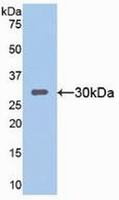
WB,IHC
WB 1:1000-1:2000IHC 1:50-1:200
80.372kD;
Sirt1 Sir2l1
q923e4
RKRE91227-Recombinant Sirtuin 1 (SIRT1) Glu236~Ala490
Rabbit
Polyclonal
Rabbit IgG
Endocrinology;
Antigen-specific affinity chromatography followed by Protein A affinity chromatography
Liquid
500μg/mL
0.01M PBS, pH7.4, containing 0.05% Proclin-300, 50% glycerol.
Store at +4℃ after thawing. For long-term storage, please store it at -20℃. Avoid repeated freeze / thaw cycles.




艾比玛特医药科技(上海)有限公司
上海市徐汇区桂平路333号聚科生物园区1号楼1-3层
邮箱:market@ab-mart.com
应聘职位:hr@ab-mart.com
订购专线:4006-123-828
销售电话:13916964679(微信同号)
技术支持:15618194176(微信同号)
华南经销商负责(广东,广西,福建,海南):
程经理:手机18616261485(微信同号)
华北经销商负责(北京,天津,河北):
徐经理:手机15618191473(微信同号)
南方经销商负责:
陆经理:手机13122837132(微信同号)
北方及西南经销商负责:
张经理:手机13122150513(微信同号)

微信客服
邮箱:market@ab-mart.com
应聘职位:hr@ab-mart.com
订购专线:4006-123-828
销售电话:13916964679(微信同号)
技术支持:15618194176(微信同号)
华南经销商负责(广东,广西,福建,海南):
程经理:手机18616261485(微信同号)
华北经销商负责(北京,天津,河北):
徐经理:手机15618191473(微信同号)
南方经销商负责:
陆经理:手机13122837132(微信同号)
北方及西南经销商负责:
张经理:手机13122150513(微信同号)
微信客服
沪ICP备17056956号-2 艾比玛特医药科技(上海)有限公司